Predicting the Photometric Redshift of Galaxies

The project presents a comprehensive investigation into estimating photometric redshifts (photo-z) via the Random Forest Regression (𝑅𝐹reg) model, trained on an expansive collection of galaxies from the Pan-STARRS1 (PS1) and Sloan Digital Sky Survey (SDSS). Utilizing 14 meticulously curated features, spanning magnitudes, colors, and mixed colors from the PS1-DR2 and unWISE datasets, the model showcases exemplary performance, particularly for redshift values below roughly 0.7. Key performance indicators, including average bias and normalized redshift difference (Δ𝑧norm), highlight its proficiency, outperforming many previous studies using similar datasets. Beyond its robust methodology, the study also introduces a groundbreaking online tool that incorporates the 𝑅𝐹reg model, facilitating straightforward photo-z estimations for users. This research underscores the promising capabilities of machine learning techniques like Random Forest Regression in advancing astronomical inquiries, setting the stage for the evolution of even more refined models and broadening our comprehension of the universe.
DOMESTiC CATS

The universe presents a captivating dance of luminous events, with cataclysmic variables (CVs) and supernovae types Ic, IIb, and Ib playing key roles. CVs are fascinating binary systems where a white dwarf star siphons off matter from its partner, leading to intermittent bursts of brilliance. Conversely, supernovae, markers of a star’s explosive end, showcase the intricate narratives of their origins through the elements present in their spectra. Types Ic, IIb, and Ib each tell a different chapter of this stellar story, based on the presence or absence of hydrogen and helium. However, the early stages of both CVs and these supernovae can appear deceptively similar, with overlapping spectral features and X-ray emissions, making them cosmic look-alikes in the vastness of space. Recognizing the need for clarity amidst this celestial confusion, I developed the machine learning tool Forest Classification in Cataclysmic Variables and Supernovae (DOMESTiC CATS). By meticulously analyzing early-time light curves and spectral nuances, this tool effectively differentiates between CVs and the specific supernovae types, proving indispensable for accurate event classification in expansive astrophysical surveys, such as the Young Supernova Experiment.
The Environment of the Peculiar & Nearby SN 2014dt
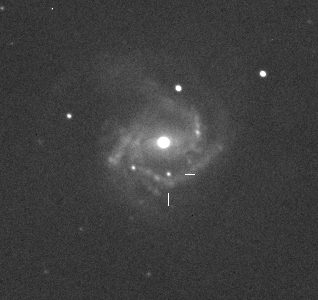
Type Iax supernovae stand out as cosmic enigmas, bearing similarities to the familiar Type Ia supernovae, yet possessing unique traits. Both stem from thermonuclear explosions within binary systems featuring white dwarf stars. However, while Type Ia events lead to the complete destruction of the white dwarf, Type Iax supernovae leave a bound remnant behind. This distinction, coupled with their dimmer and less energetic spectral signatures, points to a different explosion mechanism. A particular focus in this exploration is SN 2014dt, a recent Type Iax supernova. Its detailed X-ray and radio observations provide insights into the explosion’s environment and the history of its progenitor system. By examining SN 2014dt and similar events, this study delves into the unique nuances of Type Iax supernovae, setting them apart from the more prevalent Type Ia explosions. Radio observations of SN 2014dt allowed us to place tight constraints on the environment density of a type Iax SN though deep x-ray observations acquired at relatively early times are unable to probe the parameter space of He-star progenitors.
 Dr. Candice Stauffer